By Claire Whitaker
Updated November 2026
Homeowners who want to connect a solar array to the utility grid need a clear solar panel wiring diagram on grid, one that shows how panels, string combiners, inverters, disconnects and the main service panel fit together. Most of the printed and ebook references on this topic overlap heavily, but they differ in depth, in how they handle grid-tied versus off-grid designs, and in how much they assume about your electrical background. This list compares seven books that cover on-grid wiring, with an emphasis on who each one serves best. The selection method is research-based: we looked at listing contents, author backgrounds, the scope of each title’s wiring coverage and the feedback owners commonly report. We did not test these books or verify their diagrams against a physical installation.
Our top picks at a glance
- 1
 TOP CHOICEBest overallThe Beginner's Guide to DIY Off-Grid Solar Power: The 7-Step Sizing PlView on Amazon
- 2
 TOP CHOICEBest for complete system buildsThe DIY Off Grid Solar Power BibleView on Amazon
- 3
 TOP CHOICEBest for a hands-on walkthroughDIY HOME SOLAR POWER: The Hands-On Guide to Designing, Wiring, and InsView on Amazon
- 4
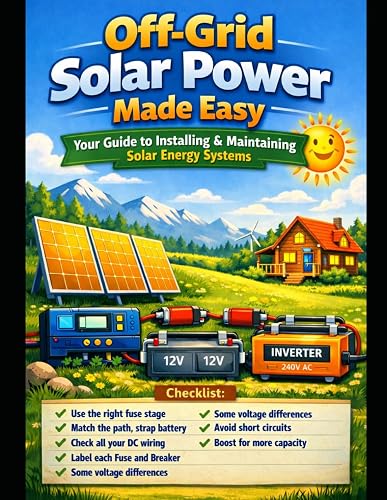 Best for first-time buildersoff grid solar power made easy: Build Your Own Off-Grid Solar SystemView on Amazon
- 5
 Best for combined solar and windDo-it-Yourself Solar and Wind Energy System: DIY Off-grid and On-gridView on Amazon
- 6
 Best for professionals and designersUSA Grid-Connected Solar PV Systems Design and Installation: A comprehView on Amazon
- 7
 Best for reference depthGrid-connected Solar Electric Systems: The Earthscan Expert Handbook fView on Amazon
Important: Grid-tied wiring involves high-voltage DC on the panel side and a live connection to your utility service. Any diagram you follow should be checked against your local electrical code (usually the National Electrical Code, NEC, as adopted by your state or city), and your utility will likely require an interconnection agreement and inspection before you energize the system. Consult a licensed electrician or solar professional before making connections to your home’s service panel.
Our Top Picks
Quick Comparison
| Product | Best for | Key feature |
|---|---|---|
| The Beginner’s Guide to DIY Off-Grid Solar Power | Homeowners new to wiring diagrams | Step-by-step sizing plan with real wiring diagrams |
| The DIY Off Grid Solar Power Bible | Readers planning a full system | Ten-in-one coverage of design, install and maintenance |
| DIY Home Solar Power | Hands-on builders | Covers both off-grid and grid-tied wiring |
| Off Grid Solar Power Made Easy | First-time builders | Stepwise build guide for homes and cabins |
| Do-it-Yourself Solar and Wind Energy System | Readers exploring hybrid setups | Covers solar panels and wind turbines, on- and off-grid |
| USA Grid-Connected Solar PV Systems Design and Installation | Installers and serious DIYers | Code-oriented grid-tied design guidance |
| Grid-connected Solar Electric Systems: The Earthscan Expert Handbook | Engineers and advanced readers | Deep technical reference on planning and design |
The Beginner’s Guide to DIY Off-Grid Solar Power: The 7-Step Sizing Plan, Real Wiring Diagrams & 4 Complete Builds
The Beginner's Guide to DIY Off-Grid Solar Power: The 7-Step Sizing Plan, Real Wiring Diagrams & 4 Complete Builds: Solar Box, Van/RV, Cabin/Tiny Home, Standalone Blackout Backup – Plus a Boat Bridge
Best for: Homeowners who want a readable first book with plenty of diagrams
This title suits readers who are starting from zero and want wiring diagrams presented alongside a sizing method. Its listing name points to a seven-step sizing plan and several complete builds, including a boat bridge, so it covers more ground than grid-tied wiring alone. Readers who want a single book to learn the basics should find it approachable.
Key specs
- Seven-step sizing plan (per the listing)
- Real wiring diagrams included (per the listing)
- Four complete build examples (solar box, van/RV, cabin/tiny home, standalone backup)
Pros
- Diagrams are the central focus, which helps visual learners
- Sizing method is organized as a repeatable sequence
- Covers several installation types in one volume
Cons
- Grid-tied coverage is secondary to off-grid builds
- Readers wanting deep code citations may need a separate code book
Bottom line: A strong starting point for a homeowner who wants diagrams and a method, though you should cross-check any grid-tie specifics against local code.
The DIY Off Grid Solar Power Bible
The DIY Off Grid Solar Power Bible: [10 in 1] The Most Complete and Updated Guide to Design, Install, and Maintain Solar Energy Systems for Tiny Homes, Cabins, Rvs, and Boats
Best for: Readers who want one broad reference covering design, installation and upkeep
The listing describes a ten-in-one guide covering design, installation and maintenance for tiny homes, cabins, RVs and boats. It is broad rather than deep, so it works well as a survey volume you return to while planning. Owners who want a single reference to sit beside their project will likely find it useful.
Key specs
- Covers design, installation and maintenance (per the listing)
- Applies to tiny homes, cabins, RVs and boats (per the listing)
Pros
- Wide scope in one book
- Useful as a planning companion
- Covers maintenance, which many titles skip
Cons
- Breadth can mean less detail on any single wiring topic
- Grid-tied specifics may be thinner than off-grid material
Bottom line: Good for a reader who wants a wide overview before committing to a specific design.
DIY Home Solar Power: The Hands-On Guide to Designing, Wiring, and Installing Your Own Off-Grid and Grid-Tied System
DIY HOME SOLAR POWER: The Hands-On Guide to Designing, Wiring, and Installing Your Own Off-Grid and Grid-Tied System
Best for: Homeowners who specifically want grid-tied wiring alongside off-grid options
The listing name explicitly covers both off-grid and grid-tied systems, which makes it one of the more relevant titles for an on-grid wiring search. Its hands-on framing suggests a practical, step-by-step emphasis rather than pure theory.
Key specs
- Covers off-grid and grid-tied systems (per the listing)
- Framed as a hands-on design, wiring and installation guide (per the listing)
Pros
- Directly addresses grid-tied wiring
- Practical framing for DIY installers
- Covers design through installation
Cons
- Recent listing, so owner feedback patterns are limited
- Readers should verify diagrams against current local code
Bottom line: A solid pick for a homeowner whose main goal is a grid-tied system and who wants practical guidance.
off grid solar power made easy: Build Your Own Off-Grid Solar System
off grid solar power made easy: Build Your Own Off-Grid Solar System (Step-by-Step for Homes & Cabins)
Best for: First-time builders who want a simple, stepwise approach
The title emphasizes ease and a step-by-step structure for homes and cabins. It is aimed at readers who find technical references intimidating and want a gentler path into system building.
Key specs
- Step-by-step build structure (per the listing)
- Targets homes and cabins (per the listing)
Pros
- Approachable tone for beginners
- Stepwise organization
- Focused on residential applications
Cons
- Off-grid emphasis means grid-tied coverage may be limited
- Simplified explanations may leave out code detail
Bottom line: Best for a complete beginner, paired with a code-focused reference for any grid connection.
Do-it-Yourself Solar and Wind Energy System: DIY Off-grid and On-grid Solar Panel and Wind Turbine System
Do-it-Yourself Solar and Wind Energy System: DIY Off-grid and On-grid Solar Panel and Wind Turbine System
Best for: Readers interested in combining solar and wind with on-grid or off-grid designs
This title covers both solar panels and wind turbines in on-grid and off-grid configurations. It suits readers who want a hybrid perspective, though wiring depth for solar alone may be less than a dedicated solar title.
Key specs
- Covers solar panel and wind turbine systems (per the listing)
- Addresses both off-grid and on-grid configurations (per the listing)
Pros
- Covers on-grid as well as off-grid
- Useful for hybrid system planning
- Broader energy context
Cons
- Older publication date, so some equipment references may be dated
- Wind content dilutes solar wiring depth
Bottom line: Suited to a reader curious about hybrid solar and wind, with the caveat that current solar equipment details should be checked elsewhere.
USA Grid-Connected Solar PV Systems Design and Installation: A comprehensive guide for solar professionals
USA Grid-Connected Solar PV Systems Design and Installation: A comprehensive guide for solar professionals from trusted experts
Best for: Installers and serious DIYers who need code-oriented grid-tied design guidance
The title is explicitly about grid-connected PV in the US and is written for solar professionals. Readers with electrical training will get the most from it, since it assumes familiarity with system design concepts.
Key specs
- Focused on grid-connected PV systems in the US (per the listing)
- Written for solar professionals (per the listing)
Pros
- Strong focus on grid-tied design
- US-specific framing
- Professional-level depth
Cons
- Assumes prior knowledge, which may overwhelm beginners
- Less focus on step-by-step homeowner builds
Bottom line: The right choice for a technically confident reader who wants US grid-tied design depth.
Grid-connected Solar Electric Systems: The Earthscan Expert Handbook for Planning, Design and Installation
Grid-connected Solar Electric Systems: The Earthscan Expert Handbook for Planning, Design and Installation
Best for: Engineers and advanced readers who want a technical reference
This handbook is positioned as an expert reference for planning, design and installation of grid-connected systems. It is dense and academic in tone, which makes it a poor fit for quick how-to reading but a strong fit for understanding why a wiring diagram is structured the way it is.
Key specs
- Expert handbook format (per the listing)
- Covers planning, design and installation of grid-connected systems (per the listing)
Pros
- Deep technical explanations
- Strong for understanding design logic
- Useful as a long-term reference
Cons
- Dense, which may slow down a homeowner
- Less focused on practical step-by-step builds
Bottom line: A reference for readers who want theory and rigor more than a quick build path.
Buying Guide
Grid-tied versus off-grid coverage
Check that the book’s title or table of contents explicitly covers grid-tied (on-grid) systems. Many solar books focus on battery-based off-grid setups, and their wiring diagrams will not show a utility interconnection, anti-islanding protection or a backfed breaker. A diagram without these elements is not a grid-tie diagram.
Good picks for this: DIY Home Solar Power, USA Grid-Connected Solar PV Systems Design and Installation
Depth of wiring diagrams
Look for diagrams that label conductor sizes, overcurrent protection, disconnect locations and grounding paths. A diagram showing only boxes and lines is less useful for a real install than one showing component ratings and connection points.
Good picks for this: The Beginner’s Guide to DIY Off-Grid Solar Power, Grid-connected Solar Electric Systems
Code references and local requirements
Wiring rules are set by the NEC and adopted locally, and utilities add their own interconnection requirements. A good book will reference the code edition it follows and tell you to confirm with your authority having jurisdiction. Treat any book that skips this as incomplete.
Good picks for this: USA Grid-Connected Solar PV Systems Design and Installation, Grid-connected Solar Electric Systems
Experience level and writing style
Be honest about your background. If you are new to electrical work, a book with plain language and worked examples will serve you better than a dense handbook, even if the handbook is more complete.
Good picks for this: off grid solar power made easy, The DIY Off Grid Solar Power Bible
Currency of the material
Solar equipment and code editions change. Check the publication date and whether the author addresses current inverter standards and recent NEC revisions. Older books can still teach principles, but verify specific ratings and requirements.
Good picks for this: DIY Home Solar Power, The Beginner’s Guide to DIY Off-Grid Solar Power
Scope beyond solar
If you plan to combine solar with wind or battery storage, check whether the book covers those components. Hybrid coverage can be helpful, but it may also reduce the attention given to solar-only wiring.
Good picks for this: Do-it-Yourself Solar and Wind Energy System, The DIY Off Grid Solar Power Bible
FAQ
What is a solar panel wiring diagram on grid?
An on-grid (grid-tied) wiring diagram shows how solar panels connect to string combiners, a grid-tied inverter, a disconnect and the home’s main service panel, with the inverter feeding power back to the utility network. It usually includes overcurrent protection, grounding and an anti-islanding feature built into the inverter.
Do I need a battery for an on-grid solar system?
No. Standard grid-tied systems do not require batteries because the utility grid acts as the storage and backup source. Battery-backed grid-tied systems exist, but their wiring is more complex and should be checked against local requirements.
Can I wire a grid-tied system myself?
Requirements vary by location. Some jurisdictions allow homeowners to perform their own electrical work with a permit, while others require a licensed electrician. Your utility will also need to approve the interconnection. Check with your local building department before starting.
Why does a grid-tie system need anti-islanding protection?
Anti-islanding stops the inverter from energizing the grid during a utility outage. Without it, a solar system could keep a downed line live, which endangers utility workers. Modern grid-tied inverters include this feature, and the diagram should show it as part of the inverter’s listed functions.
What should a grid-tie diagram include?
At minimum: the array and string layout, DC disconnect, inverter, AC disconnect, overcurrent protection on both DC and AC sides, grounding and bonding, the point of interconnection to the service panel, and labeling. Compare any diagram against your local code and your inverter’s installation manual.
Is it safe to follow a diagram from a book?
A diagram is a starting point, not a substitute for code compliance or a site-specific design. Confirm conductor sizes, breaker ratings and equipment listings against current code and the manufacturer’s instructions. When in doubt, consult a licensed electrician or solar professional.
Conclusion
For most homeowners, the best starting point is a book that explicitly covers grid-tied wiring and pairs diagrams with a clear method. DIY Home Solar Power and The Beginner’s Guide to DIY Off-Grid Solar Power are strong general choices. Readers who want grid-tied depth should look at USA Grid-Connected Solar PV Systems Design and Installation, while those who want an expert reference will find the Earthscan handbook thorough. Beginners who need a gentler introduction may prefer off grid solar power made easy. Whatever you choose, check every diagram against your local code and get professional review before energizing a grid connection.
Sources
- Federal guidance on solar energy systems, grid interconnection basics and consumer solar planning (energy.gov)
- Information on the National Electrical Code, including the articles that govern photovoltaic system wiring (nfpa.org)
- Standards and technical resources on grid-interconnected inverters and distributed generation
Related reading
- Wiring Diagrams for Solar Panel Installation: 4 Best Guides (2026)
- Solar Panel Parallel Wiring Diagram: Step-by-Step Guide for Homeowners
- Series-Parallel 48V Solar Panel Wiring Diagram: Step-by-Step Guide
- Eco Worthy Solar Panel Wiring Diagram PDF: A Step-by-Step Guide
- Boat Solar Panel Wiring Diagram: 5 Steps for a Safe Build (2026)
- 6 Best Solar Panel Battery Wiring Diagram Guides for Homeowners (2026)
About Claire Whitaker
Claire Whitaker is part of our editorial team and reviews and edits our home solar guides, checking product details against manufacturer specifications and owner feedback.