By Claire Whitaker
Updated November 2026
Homeowners who want to understand solar panel production plant cost usually run into the same problem: most online material is written for manufacturers or investors, not for someone deciding whether building or buying panels makes sense for a house. This list narrows the field to four books that explain the economics, the components and the trade-offs in plain language. Selection criteria were the depth of the cost breakdown, how clearly the material separates residential from commercial scale, whether it covers installation, permitting and contractor choices, and how consistently owners describe the content as practical. We did not run any of these in a lab or build anything from them; the picks reflect publisher descriptions, listing details and common reader feedback patterns.
Our top picks at a glance
- 1
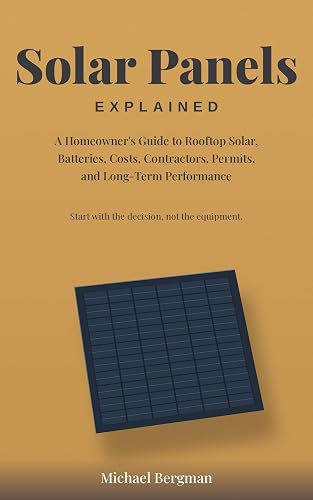 TOP CHOICEBest overallSolar Panels Explained: A Homeowner's Guide to Rooftop Solar, BatterieView on Amazon
- 2
 Best for system design and sizingThe Sun-to-Storage Blueprint: The Ultimate Solar Hybrid Design & Feasibility HandbookView on Amazon
- 3
 Best for Spanish-speaking readersCurso de PANELES SOLARES: Electricidad, Sistema FV, costos, tecnologíaView on Amazon
- 4
 Best for maximizing returnsThe Solar Profit Strategy: The Homeowner's No-Fluff Guide to Maximising System PerformanceView on Amazon
Our Top Picks
Quick Comparison
| Product | Best for | Key feature |
|---|---|---|
| Solar Panels Explained | Homeowners starting from zero | Covers rooftop systems, batteries, costs, contractors and permits |
| The Sun-to-Storage Blueprint | Readers focused on sizing and feasibility | Battery selection and cost analysis for homes and small sites |
| Curso de Paneles Solares | Spanish-speaking readers | Covers electricity basics, PV systems, costs and mounting |
| The Solar Profit Strategy | Owners optimizing an existing or planned system | Performance maximization and avoiding common costly mistakes |
Solar Panels Explained: A Homeowner’s Guide to Rooftop Solar, Batteries, Costs, Contractors, Permits, and Long-Term Performance
Solar Panels Explained: A Homeowner's Guide to Rooftop Solar, Batteries, Costs, Contractors, Permits, and Long-Term Performance
Best for: Overall cost literacy for homeowners
This book suits someone who wants the full picture before talking to a contractor. Its scope runs from rooftop panel basics through battery storage, so readers can see how solar panel production plant cost fits into the wider question of what a household system actually costs and returns.
Key specs:
- Format: paperback, aimed at general readers
- Topics: rooftop solar, batteries, costs, contractors, permits, long-term performance
Pros:
- Breaks down cost categories a homeowner will actually encounter
- Explains how to evaluate contractors and read permit requirements
- Written for non-engineers without skipping the important numbers
Cons:
- Less depth on manufacturing-scale equipment than industry texts
- Regional permit details will vary by locality, so readers must verify locally
Bottom line: The safest first pick for a homeowner who wants one book covering costs, contractors and long-term performance.
The Sun-to-Storage Blueprint: The Ultimate Solar Hybrid Design & Feasibility Handbook
THE SUN-TO-STORAGE BLUEPRINT: The Ultimate Solar Hybrid Design & Feasibility Handbook Practical Sizing, Battery Selection and Cost Analysis for Homes, Businesses and Solar Farms Author: Mark Rannel
Best for: System sizing and feasibility analysis
Readers who want to model a solar setup before committing money will find this one useful. It is framed around hybrid design, battery selection and cost analysis for homes, businesses and larger solar sites, so it reaches further than a typical homeowner guide.
Key specs:
- Author: Mark Rannel
- Focus: hybrid design, feasibility, practical sizing, battery selection, cost analysis
Pros:
- Strong on sizing logic, which helps translate cost estimates into system choices
- Covers homes and larger sites, useful for readers scaling up later
- Feasibility framing encourages checking assumptions before buying
Cons:
- Denser than a beginner guide and assumes some comfort with numbers
- Coverage of contractor selection and permitting is lighter than in general guides
Bottom line: A good second book for readers who already understand the basics and want to model a design.
Curso de Paneles Solares: Electricidad, Sistema FV, costos, tecnología, instalación, montaje (Spanish Edition)
Curso de PANELES SOLARES: Electricidad, Sistema FV, costos, tecnología, instalación, montaje. Instala tus propios paneles solares fotovoltaicos (Spanish Edition)
Best for: Spanish-speaking readers who want a self-install overview
This title covers electricity fundamentals, photovoltaic system layout, costs, technology, installation and mounting in Spanish. It suits readers who want to understand the build process as well as the financial side.
Key specs:
- Language: Spanish
- Topics: electricity, PV systems, costs, technology, installation, mounting
Pros:
- Good coverage of installation and mounting for hands-on readers
- Explains electrical basics before moving into system design
- Useful for households and communities where Spanish is the primary language
Cons:
- Not available in English, limiting use for English-speaking U.S. readers
- Electrical code references may not match U.S. standards, so local rules must be checked
Bottom line: The right pick for Spanish-speaking homeowners who want a build-focused overview.
The Solar Profit Strategy: The Homeowner’s No-Fluff Guide to Maximising System Performance
The Solar Profit Strategy: The Homeowner’s No-Fluff Guide to Maximising System Performance, Avoiding Costly Mistakes, and Making Solar Work Like a Real Asset
Best for: Maximizing returns from a solar investment
Owners who already have panels, or are close to buying, often care most about performance and avoiding expensive errors. This book is framed around those goals, which makes it a natural companion to a cost-focused reading list.
Key specs:
- Focus: system performance, avoiding costly mistakes, treating solar as a real asset
Pros:
- Emphasis on performance over raw purchase price
- Practical framing aimed at protecting the investment
- Short, direct style suits readers who want fewer pages
Cons:
- Less detail on the mechanics of building or wiring a system
- Return claims depend heavily on local utility rates and incentives, which the book cannot fix for every reader
Bottom line: Pick this if your main question is how to get the most out of a solar system you own or plan to buy.
Buying Guide
Scope: residential versus commercial production
Many texts on solar panel production plant cost describe factory-scale manufacturing, with equipment, cleanroom, and throughput figures that have little to do with a home. Check whether the book is aimed at a homeowner, an installer, or a manufacturer before you buy. A mismatch here wastes time and money.
Good picks for this: Solar Panels Explained, The Sun-to-Storage Blueprint
Cost breakdown detail
A useful guide separates hardware, labor, permitting, interconnection and balance-of-system costs instead of quoting one lump figure. Look for tables or worked examples that show how each line item changes with system size.
Good picks for this: Solar Panels Explained, The Sun-to-Storage Blueprint
Sizing and feasibility methods
Check whether the book explains how to calculate system size from energy use, roof area and sun exposure. Feasibility methods are what turn general cost information into a decision about your own property.
Good picks for this: The Sun-to-Storage Blueprint, The Solar Profit Strategy
Language and regional standards
Electrical codes, permit processes and incentives differ by country and state. If a book is written for another market, verify every code reference and cost assumption against your local authority.
Good picks for this: Curso de Paneles Solares, Solar Panels Explained
Installation and mounting coverage
If you plan to install yourself or supervise a contractor, look for practical coverage of mounting hardware, roof attachment and wiring. Books that cover installation in addition to cost give you a clearer checklist.
Good picks for this: Curso de Paneles Solares, Solar Panels Explained
Performance and long-term value
Good guides discuss degradation, maintenance and how performance affects payback. A book that only covers purchase cost will leave out the variables that most affect returns over time.
Good picks for this: The Solar Profit Strategy, Solar Panels Explained
Depth versus readability
Dense handbooks give more numbers but assume prior knowledge. Shorter guides are easier to finish but may skip the calculations. Choose based on how much background you already have.
Good picks for this: Solar Panels Explained, The Solar Profit Strategy
FAQ
What does solar panel production plant cost usually include?
Industry estimates typically cover land, buildings, cleanroom or process areas, production equipment, utilities, labor, and working capital. Figures vary widely with plant size and cell technology. For a homeowner, the more relevant question is the cost of panels and installation, which is a different topic.
Are these books useful if I only want to buy panels for my house?
Yes, especially Solar Panels Explained and The Sun-to-Storage Blueprint. Both focus on residential or small-site decisions more than factory economics.
Do I need to read a book in Spanish if I am in the United States?
Only if you are more comfortable in Spanish. The Spanish-language title is useful for readers in that language, but U.S. readers should check any code references against the National Electrical Code and local rules.
Will a book tell me exactly what my system will cost?
No. Books can explain the variables and methods, but final costs depend on your roof, location, equipment and local labor. Get written quotes from licensed installers.
How current are the figures in these books?
Solar equipment and incentive rules change quickly. Use the books for method and structure, then confirm current prices, incentives and tax rules from current sources.
Should I hire a professional before making a decision?
Yes. A licensed electrician or solar installer should review any system design, and a tax or financial advisor can help with incentives and financing.
Conclusion
For most homeowners, Solar Panels Explained is the most practical starting point because it connects costs, contractors and permits in one place. Readers who want to model a system should look at The Sun-to-Storage Blueprint. Spanish-speaking readers who want an installation-focused overview should consider Curso de Paneles Solares. Owners who already have or plan to buy a system and care most about performance will find The Solar Profit Strategy most relevant. Whichever you choose, confirm numbers with local professionals before committing.
Sources
- Federal guidance on residential solar, system costs and incentives (energy.gov)
- Research on solar technology, system cost benchmarks and performance (nrel.gov)
- Electrical code standards that apply to solar installations in the United States (nfpa.org)
Related reading
- Top 5 Solar Panel Manufacturing Plant Cost Guides for Homeowners Compared
- Solar Panel Recycling Plant Cost: What Owners and Investors Should Expect
- What Is the Cost of Roof Solar Panels? A Homeowner's Q&A
- What Does the Cost of Thermal Solar Panels Look Like for a Home?
- Vivint Solar Panel Cost: What Homeowners Should Expect Before Signing
- Top 5 Solar Panel Removal Cost Calculator Tools for Homeowners
- Top 5 Solar Panel Installation Cost Estimator Tools Compared (2026)
- Tesla Solar Panel System Cost: What Homeowners Should Expect
About Claire Whitaker
Claire Whitaker is part of our editorial team and reviews and edits our home solar guides, checking product details against manufacturer specifications and owner feedback.