As an Amazon Associate I earn from qualifying purchases. This page may contain affiliate links.
Net metering for commercial solar systems depends on accurate, two-way energy measurement. Your utility bills on the net energy you export to the grid and the energy you draw from it, so a meter or monitor that tracks both directions at the service entrance is the foundation of checking your bills and your solar production. This list covers six products that sit on that measurement layer, from three-phase revenue-style meters to energy monitors and reference reading material. Each was chosen by comparing published specifications, manufacturer documentation, brand reputation and common owner feedback patterns. None were tested in our own setup.
The criteria we used were: phase support (single-phase versus three-phase, since most commercial services are three-phase), current rating and clamp size for the main service, bidirectional measurement for net metering, data access (app, local network or Modbus), and whether the product is aimed at monitoring, metering or education. Keep in mind that a monitoring device is not the same as the utility’s billing meter, and your utility’s interconnection rules always take precedence.
Our Top Picks
Quick Comparison
| Product | Best for | Key feature |
|---|---|---|
| EB6-EW-E3-180-3000A 3-Phase Energy Meter | Large three-phase commercial mains with high current | 3000A rated, Rogowski flex current transformers |
| Emporia Vue 3 Home Energy Monitor | Small sites and single-phase service monitoring | Circuit-level monitoring with solar and net metering view |
| Emporia Vue 3 Commercial 3-Phase Smart Energy Monitor | Three-phase businesses wanting solar and net metering tracking | Three-phase monitoring with solar and net metering |
| Bi-Directional Din Rail Solar PV Power Usage Monitor (WEM3080T style) | Panel builders and integrators using DIN rail hardware | Bidirectional metering with Modbus output |
| Smart Metering Applications: Main Concepts and Business Models | Engineers and planners studying metering business models | Conceptual overview of smart metering programs |
| Electricity Metering in Easy Steps | Beginners who want a plain-language introduction | Accessible outline of smart energy meters |
Real-Time kWh/W/A/V/PF/$ Data, Solar & Net Metering, 3x3000A 180mm Flex CTs, Model EB6-EW-E3-180-3000A
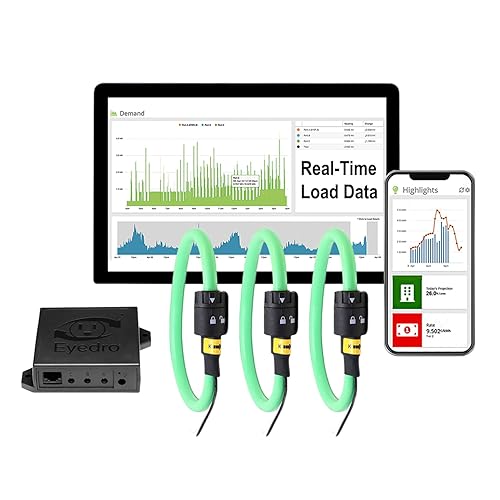
Real-Time kWh/W/A/V/PF/$ Data, Solar & Net Metering, 3x3000A 180mm Flex CTs, Model EB6-EW-E3-180-3000A, Made in North America 3-Phase Energy Meter 3000A/600V 2.4GHz WiFi/Ethernet (7" Rogowski)
Who it’s for: Commercial sites with three-phase service and large main feeds that need bidirectional energy data at the service entrance, such as facilities with substantial rooftop or ground-mount solar.
Key specs
- Three-phase energy meter, 3000A / 600V rating (per listing name)
- Three 3000A, 180mm flexible (Rogowski) current transformers
- 2.4GHz WiFi and Ethernet connectivity (per listing name)
- Reports kWh, W, A, V, power factor and cost data (per listing name)
Pros
- Flexible CTs make installation on large conductors easier than rigid clamps.
- Covers solar and net metering in one device.
- Network connectivity supports remote monitoring.
Cons
- Installation on high-current mains should be done by a licensed electrician.
- Likely more capability than a small shop or office needs.
Emporia Vue 3 Home Energy Monitor

Emporia Vue 3 Home Energy Monitor – Smart Home Automation Module and Real Time Electricity Usage Monitor, Power Consumption Meter, Solar and Net Metering for UL Certified Safe Energy Monitoring
Who it’s for: Small commercial spaces or single-phase service where the owner wants a simple way to see consumption and solar export without a full three-phase installation.
Key specs
- Home energy monitor with solar and net metering support (per listing name)
- Smart home automation module (per listing name)
- UL certified, per listing name
Pros
- Lower complexity for single-phase sites.
- Clear view of solar production versus grid draw.
- Owners often report a straightforward setup.
Cons
- Not designed for three-phase commercial service.
- Monitoring only; it does not replace the utility billing meter.
Emporia Vue 3 Commercial 3-Phase Smart Energy Monitor

Emporia Vue 3 Commercial 3-Phase Smart Energy Monitor – Business and Home Automation Device with Real Time Electricity Usage Monitor, Power Consumption Meter, Solar and Net Metering
Who it’s for: Businesses on three-phase service that want to track solar generation and net metering flow with a monitor rather than a utility-grade meter.
Key specs
- Three-phase commercial energy monitor (per listing name)
- Solar and net metering functions (per listing name)
- Real-time electricity usage monitoring (per listing name)
Pros
- Matches three-phase commercial service, unlike the home version.
- Useful for checking whether solar production is offsetting load.
- Owners often mention a clear app interface.
Cons
- Monitoring accuracy is not the same as a revenue-grade billing meter.
- Installation still needs a qualified electrician for three-phase wiring.
Bi-Directional Din Rail Solar PV Power Usage Monitor, Three Phase, WEM3080T
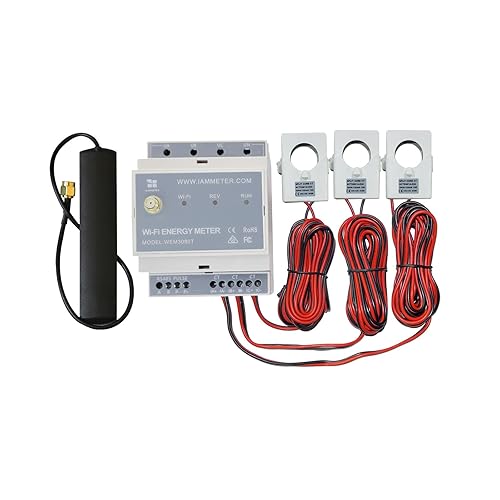
Bi-Directional,Din Rail,Monitor Solar PV,Power Usage Monitor,Modbus TCP/RTU, Three Phase Energy Meter, Net Energy metering,WiFi,Split Phase,250A,WEM3080T,Home Assistant,CE,FCC,RCM
Who it’s for: Electricians, integrators and technically inclined owners who want a DIN rail meter with bidirectional measurement and Modbus output for building automation.
Key specs
- Bi-directional, DIN rail mounted, three-phase meter (per listing name)
- 250A rating and Modbus TCP/RTU (per listing name)
- WiFi and Home Assistant compatibility (per listing name)
Pros
- DIN rail format suits panel-based installations.
- Modbus output allows integration with building controls.
- Bidirectional measurement fits net metering needs.
Cons
- Requires panel wiring knowledge and should be installed by a professional.
- The 250A rating may be too small for large commercial mains.
Smart Metering Applications: Main Concepts and Business Models

Smart Metering Applications: Main Concepts and Business Models (Lecture Notes in Energy, 88)
Who it’s for: Energy managers, planners and students who want to understand how smart metering programs and their business models work, including the role of net metering.
Key specs
- Part of the Lecture Notes in Energy series, volume 88 (per listing name)
- Academic-style reference on smart metering concepts
Pros
- Explains the economics behind metering programs.
- Useful background for policy and billing discussions.
- Suitable for technical readers without hardware.
Cons
- Not a hands-on guide to installing meters or monitors.
- Academic depth may be more than a typical site owner needs.
Electricity Metering in Easy Steps

Electricity Metering in Easy Steps: An outline book on smart energy meters for everyone
Who it’s for: Business owners and staff new to energy metering who want a plain-language introduction before talking to an installer or utility.
Key specs
- Outline book on smart energy meters for general readers (per listing name)
Pros
- Plain language suitable for non-engineers.
- Short enough to read in a few sittings.
- Good primer before reading manufacturer documentation.
Cons
- Does not cover commercial three-phase details or current utility rules.
- Dated information is possible, so verify against your utility’s current tariff.
Buying Guide
Choosing equipment for net metering for commercial sites starts with understanding what your utility requires. Most utilities use a bidirectional revenue meter at the point of interconnection, and any monitor you add is for your own visibility. Before buying, confirm with your utility whether they accept any third-party data, and whether your interconnection agreement requires specific metering equipment.
Selection Criteria
- Phase support. Most commercial services are three-phase. A single-phase monitor will give incomplete data.
- Current rating and clamp size. Match the rating to your main service amperage and confirm the conductor will fit the clamps.
- Bidirectional measurement. Net metering requires seeing both imports and exports.
- Data access. Look for an app, local network access, or Modbus output if you use a building management system.
- Certification. Check for listings such as UL or CE that match your jurisdiction.
Specs to Check
- Voltage rating and the service configuration it supports (single-phase, split-phase, or three-phase).
- Maximum current and the CT sizes that come with the unit.
- Communication protocols and whether they fit your existing systems.
- Whether the product is a monitor or a revenue-grade meter.
Choosing by Need
- Large three-phase site with solar: a high-current meter with flexible CTs.
- Small single-phase or light commercial load: a consumer-style energy monitor.
- Three-phase business wanting monitoring without full metering: a commercial 3-phase monitor.
- Integrator or panel builder: a DIN rail meter with Modbus.
- Learning before buying: reference books.
Things to Watch Out For
- Monitors are not billing meters. Do not rely on them for utility settlement without utility approval.
- Electrical work at the service entrance is dangerous and often requires a licensed electrician and a permit.
- Check that CT orientation and phase labeling are correct, or net flow readings will be wrong.
For details on how interconnection and outages affect your system, see How Grid-Tied Solar Works: Net Metering, Interconnection and Outages.
FAQ
What is net metering for commercial solar systems?
Net metering lets a commercial site receive credit for solar energy it exports to the grid, which offsets energy it draws later. Credits and rules vary by utility and state, so confirm the terms in your interconnection agreement.
Do I need a special meter for net metering?
Usually yes. Your utility typically requires a bidirectional meter at the point of interconnection. A consumer monitor can supplement that but generally does not replace it.
Can a three-phase commercial building use a home energy monitor?
Not reliably. Home monitors are typically designed for single-phase service. Three-phase sites need equipment that measures all phases.
Who installs commercial metering equipment?
A licensed electrician, often coordinated with your utility and solar installer. Work at the service entrance usually requires permits and utility inspection. Consult a qualified professional before making changes to your main service.
What happens to excess credits at the end of a billing period?
Policies differ. Some utilities roll credits forward, some pay out at a set rate, and some cap them. Check your tariff, because this detail heavily affects system sizing.
Are monitoring apps accurate enough for billing checks?
They are useful for trends and troubleshooting. For billing disputes, rely on your utility’s meter data and statements.
Conclusion
For a large three-phase commercial site with solar, a high-current meter with flexible CTs such as the EB6-EW-E3-180-3000A model fits the job best, provided a licensed electrician handles installation. Businesses that want three-phase monitoring without utility-grade hardware should look at the Emporia Vue 3 Commercial 3-Phase monitor. Single-phase or small sites are better served by the Emporia Vue 3 Home monitor. Integrators will value the DIN rail WEM3080T-style meter for Modbus integration. The two books suit readers who want to understand metering before buying. Whatever you choose, confirm requirements with your utility before installing.