By Claire Whitaker
Updated November 2026
Homeowners who want to understand how sb 1024 net metering affects their solar credits usually need a meter that can track power flowing both into and out of the home. This list compares seven bidirectional energy monitors that list solar and net metering support. Our selection criteria were specifications stated in each listing, the type of metering they provide (single-phase or three-phase, clamp-on or DIN rail), smart-home integration, the number of circuits monitored, and patterns that owners commonly mention in feedback, such as installation effort and app reliability. Every product below is an energy monitor, not a solar panel or inverter.
Our top picks at a glance
- 1
 TOP CHOICEBest overallEMPORIA Vue 3 Home Energy Monitor – Smart Home Automation Module and RView on Amazon
- 2
 TOP CHOICEBest for three-phase homesEnergy Monitor with 3 * 120A Clamp, 1/3 Phase, Home Power Monitor RealView on Amazon
- 3
 TOP CHOICEBest for DIN rail installsWiFi , Solar Net Metering, 15-Second Refresh, 2% Calibrated Accuracy,View on Amazon
- 4
 Best for multi-circuit trackingReal-Time Power Usage Monitor with Native Open API, Home Assistant, ElView on Amazon
- 5
 Best for Home Assistant usersBi-Directional,Din Rail,Monitor Solar PV,Power Usage Monitor,Home-AssiView on Amazon
- 6
 Best for commercial-grade accuracyReal-Time kWh/W/A/V/PF/$ Data, Solar & Net Metering, 3x500A 110mm FlexView on Amazon
- 7
 Best budget pickDin Rail mount, 2.4GHz app control, solar net metering, Tuya Smart comView on Amazon
Our Top Picks
Quick Comparison
| Product | Best for | Key feature |
|---|---|---|
| EMPORIA Vue 3 Home Energy Monitor | Most homeowners with rooftop solar | Solar and net metering with UL-listed safety labeling |
| Energy Monitor with 3 * 120A Clamp | Three-phase homes | Three split-core clamps for 1/3 phase monitoring |
| WiFi Solar Net Metering Smart Energy Monitor 80A | Electrical panel mounting | DIN rail mount with 15-second refresh |
| Refoss Smart Home Energy Monitor | Detailed circuit-level tracking | 16 circuit sensors with open API |
| Bi-Directional Din Rail Three Phase Energy Meter | Home Assistant and Modbus setups | Modbus TCP/RTU and bidirectional metering |
| 3-Phase Energy Meter 500A/600V | Large or high-amperage systems | Flexible 110mm Rogowski CTs |
| WALFRONT Single Phase Energy Meter 100A | Single-phase homes on a budget | Five 100A CTs with app control |
EMPORIA Vue 3 Home Energy Monitor – Smart Home Automation Module and Real Time Electricity Usage Monitor, Power Consumption Meter, Solar and Net Metering for UL Certified Safe Energy Monitoring
EMPORIA Vue 3 Home Energy Monitor – Smart Home Automation Module and Real Time Electricity Usage Monitor, Power Consumption Meter, Solar and Net Metering for UL Certified Safe Energy Monitoring
Best for: Most homeowners with rooftop solar who want a straightforward way to see solar production and grid import/export.
This is a good starting point for a household that wants to see how much solar is offsetting consumption and how much is flowing back to the utility under net metering rules. It is aimed at owners who want app-based tracking without complex wiring.
Key specs
- Solar and net metering monitoring (per listing)
- Real-time electricity usage display
- Smart home automation module
- UL-certified safety labeling (per listing)
Pros
- Clear separation of solar production and grid flow
- Smart home integration for automation rules
- Widely discussed by owners for approachable setup
Cons
- Advanced circuit-level detail is more limited than multi-sensor systems
- Some owners report needing to refine clamp placement for accurate readings
Bottom line: The best choice for most homeowners who want reliable solar and net metering visibility with minimal complexity.
Energy Monitor with 3 * 120A Clamp, 1/3 Phase, Home Power Monitor Real Time Electricity Monitor/Meter, WIFi Meter Solar/Net Metering, Home Energy Automation and Control
Energy Monitor with 3 * 120A Clamp, 1/3 Phase, Home Power Monitor Real Time Electricity Monitor/Meter, WIFi Meter Solar/Net Metering, Home Energy Automation and Control
Best for: Three-phase homes that need to monitor each phase separately.
Homes with three-phase service or with large loads spread across phases benefit from three clamps and per-phase data. It suits owners comfortable installing split-core clamps around service conductors.
Key specs
- Three 120A clamps (per listing)
- Supports 1-phase and 3-phase configurations (per listing)
- WiFi connectivity and solar/net metering (per listing)
Pros
- Per-phase visibility for balancing loads
- Split-core clamps avoid rewiring the service
- Home automation control options
Cons
- Clamp placement requires care to read correctly
- Setup is more involved than single-clamp monitors
Bottom line: A strong pick for three-phase households that want per-phase data alongside solar tracking.
WiFi, Solar Net Metering, 15-Second Refresh, 2% Calibrated Accuracy, 100-240V DIN Rail Mount Smart Energy Monitor Bidirectional 80A Single Phase
WiFi , Solar Net Metering, 15-Second Refresh, 2% Calibrated Accuracy, 100-240V DIN Rail Mount Smart Energy Monitor Bidirectional 80A Single Phase
Best for: Electrical panel installs where a DIN rail mount keeps the meter tidy inside the panel.
Owners comfortable working in a breaker panel, or working with an electrician, may prefer a DIN rail meter. It fits a single-phase service rated for 80A.
Key specs
- Bidirectional 80A single-phase metering (per listing)
- 15-second refresh rate (per listing)
- 2% calibrated accuracy (per listing)
- 100–240V DIN rail mount (per listing)
Pros
- Compact DIN rail form factor
- Frequent refresh rate for near-live data
- Stated calibrated accuracy
Cons
- Panel installation requires electrical work or professional help
- Not suited to three-phase services
Bottom line: Best for single-phase homes where a clean in-panel install is preferred.
Real-Time Power Usage Monitor with Native Open API, Home Assistant, Electricity Cost Tracking, Solar Metering, ETL Certified Refoss Smart Home Energy Monitor with 16 60A Circuit Sensor, Local Control
Real-Time Power Usage Monitor with Native Open API, Home Assistant, Electricity Cost Tracking, Solar Metering, ETL Certified Refoss Smart Home Energy Monitor with 16 60A Circuit Sensor, Local Control
Best for: Households that want circuit-by-circuit detail, such as tracking an EV charger or heat pump separately.
Sixteen circuit sensors give a far more granular picture than a whole-home clamp. This suits owners who want to know which appliances drive their solar exports or imports.
Key specs
- 16 circuit sensors rated 60A (per listing)
- Open API and Home Assistant compatibility (per listing)
- Solar metering and electricity cost tracking (per listing)
- ETL certification (per listing)
Pros
- Circuit-level visibility for targeted energy decisions
- Local control options
- Open API suits custom dashboards
Cons
- More sensors mean more installation time
- Can be more than most homeowners need
Bottom line: Ideal for detail-focused owners who want to track individual circuits alongside solar and net metering.
Bi-Directional, Din Rail, Monitor Solar PV, Power Usage Monitor, Home-Assistant, Modbus TCP/RTU, Three Phase Energy Meter, Net Energy metering, WiFi, Split Phase, 150A, WEM3080T, CE, FCC, UL
Bi-Directional,Din Rail,Monitor Solar PV,Power Usage Monitor,Home-Assistant,Modbus TCP/RTU, Three Phase Energy Meter, Net Energy metering, WiFi,Split Phase,150A,WEM3080T,CE,FCC,UL
Best for: Home Assistant users and integrators who need Modbus connectivity.
This meter is oriented toward technically inclined owners who want to pull data into a custom system. Modbus support makes it useful for integration with other equipment.
Key specs
- Bidirectional net energy metering (per listing)
- Modbus TCP/RTU support (per listing)
- Split-phase and three-phase compatibility (per listing)
- 150A rating (per listing)
Pros
- Modbus gives strong integration options
- Home Assistant compatibility
- DIN rail mounting for panel installs
Cons
- Configuration can be technical for beginners
- Requires careful wiring by a qualified person
Bottom line: A strong fit for Home Assistant enthusiasts who want Modbus data in their own system.
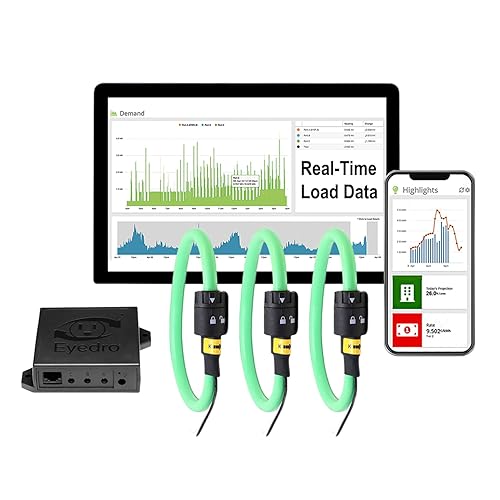
Real-Time kWh/W/A/V/PF/$ Data, Solar & Net Metering, 3x500A 110mm Flex CTs, Model EB6-EW-E3-110-500A, Made in North America 3-Phase Energy Meter 500A/600V 2.4GHz WiFi/Ethernet (4″ Rogowski)
Real-Time kWh/W/A/V/PF/$ Data, Solar & Net Metering, 3x500A 110mm Flex CTs, Model EB6-EW-E3-110-500A, Made in North America 3-Phase Energy Meter 500A/600V 2.4GHz WiFi/Ethernet (4" Rogowski)
Best for: Large or high-amperage systems where standard clamps are too small.
Flexible Rogowski coils fit around large conductors and are useful for big homes, workshops or systems with heavy loads. This meter is better suited to owners who want detailed electrical parameters such as power factor.
Key specs
- Three 500A flexible 110mm CTs (per listing)
- Three-phase, 500A/600V rating (per listing)
- 2.4GHz WiFi and Ethernet connectivity (per listing)
- Solar and net metering support (per listing)
Pros
- Handles high-amperage conductors
- Reports power factor and detailed parameters
- Ethernet option for stable wired connection
Cons
- Overkill for typical residential service
- Rogowski coil installation takes more care
Bottom line: Best for high-load or three-phase installations that need heavy-duty current capacity.
Din Rail mount, 2.4GHz app control, solar net metering, Tuya Smart compatible, 1% accuracy, 5 x 100A CTs WALFRONT Single Phase Energy Meter, Bidirectional 100A WiFi Monitor
Din Rail mount, 2.4GHz app control, solar net metering, Tuya Smart compatible, 1% accuracy, 5 x 100A CTs WALFRONT Single Phase Energy Meter, Bidirectional 100A WiFi Monitor
Best for: Single-phase homes on a budget that want app control and solar tracking.
This meter offers a broad feature set for a single-phase service, including five current transformers and Tuya app compatibility. It suits owners who want a practical, mid-range option.
Key specs
- Bidirectional 100A single-phase metering (per listing)
- Five 100A current transformers (per listing)
- 1% accuracy (per listing)
- Tuya Smart compatible, 2.4GHz app control (per listing)
Pros
- Multiple CTs for circuit-level detail
- Tuya app compatibility
- DIN rail mounting
Cons
- Single-phase only
- Owners report that app setup can take some troubleshooting
Bottom line: A sensible choice for single-phase homeowners who want app control without a premium price tier.
Buying Guide
Single-phase versus three-phase service
Check your main panel or utility bill to confirm whether your home has single-phase or three-phase service. A single-phase meter in a three-phase home will miss part of the load and produce incomplete net metering data.
Good picks for this: EMPORIA Vue 3 Home Energy Monitor, WALFRONT Single Phase Energy Meter 100A
Bidirectional metering
Net metering requires a meter that records power flowing in both directions. Confirm that the listing explicitly states bidirectional or net metering support before buying.
Good picks for this: WiFi Solar Net Metering Smart Energy Monitor 80A, Bi-Directional Din Rail Three Phase Energy Meter WEM3080T
Current rating and clamp size
Match the meter’s current rating to your service size and the clamp or CT diameter to your conductors. Split-core clamps are easier to fit around existing wiring, while Rogowski coils handle larger conductors.
Good picks for this: 3-Phase Energy Meter 500A/600V with Rogowski CTs, Energy Monitor with 3 * 120A Clamp
Circuit-level monitoring
Whole-home meters show total usage, while circuit sensors reveal which appliances drive consumption. If you plan to track an EV charger or heat pump, consider a multi-sensor setup.
Good picks for this: Refoss Smart Home Energy Monitor, WALFRONT Single Phase Energy Meter 100A
Installation method
DIN rail meters mount inside an electrical panel, while clamp-on monitors install around conductors. Panel work involves live electrical components, so hire a licensed electrician if you are not qualified.
Good picks for this: WiFi Solar Net Metering Smart Energy Monitor 80A, Bi-Directional Din Rail Three Phase Energy Meter WEM3080T
Smart home and data integration
Consider whether you want a phone app, a local dashboard or integration with Home Assistant or Modbus systems. Confirm which protocols each product lists before committing.
Good picks for this: Refoss Smart Home Energy Monitor, Bi-Directional Din Rail Three Phase Energy Meter WEM3080T
Safety certifications
Look for certifications such as UL, ETL or CE on the listing. Certification indicates the product has been evaluated against a safety standard, though it does not guarantee a correct installation.
Good picks for this: EMPORIA Vue 3 Home Energy Monitor, Refoss Smart Home Energy Monitor
FAQ
What does sb 1024 net metering mean for a homeowner?
sb 1024 net metering refers to California’s net metering framework established by Senate Bill 1024, which governs how solar exports are credited against household consumption. A bidirectional meter is needed to record both imported and exported power. Your utility determines the exact rules for your account.
Do I need a special meter for net metering?
Yes. Net metering requires a meter that records electricity flowing in both directions. Your utility typically supplies or approves the official meter, and a third-party monitor is usually added for tracking rather than billing.
Can a homeowner install a monitor themselves?
Clamp-on monitors are often installed by owners comfortable working around electrical equipment, while DIN rail meters require panel access. Because panel work involves live circuits, consult a licensed electrician before installing any product inside your service panel.
Will a monitor change my utility bill?
A third-party monitor generally does not change billing on its own. Your utility bill depends on the official meter and your rate plan. Monitors help you understand usage and solar production so you can compare with your bill.
Is single-phase or three-phase better for solar monitoring?
Neither is better in general. The correct choice depends entirely on your home’s service type. Check your panel or utility documentation to confirm before buying.
How accurate are home energy monitors?
Accuracy varies by product. Some listings state a percentage such as 1% or 2%. Treat marketing accuracy figures as manufacturer claims and compare them with your utility’s official readings.
Conclusion
For most homeowners navigating sb 1024 net metering, the EMPORIA Vue 3 is a practical starting point because it focuses on solar and net metering visibility. Three-phase households should look at the 120A clamp monitor or the 500A Rogowski meter. Owners who want circuit-level detail can consider the Refoss sixteen-sensor system, while Home Assistant users may prefer the Modbus-capable WEM3080T. The WALFRONT 100A meter suits single-phase homes that want app control on a budget. Always confirm your service type and your utility’s net metering rules before purchasing, and involve a licensed electrician for any panel installation.
Sources
- Background on residential solar, net metering concepts and how home energy systems are regulated (energy.gov)
- Research on distributed solar generation and metering practices for homeowners (nrel.gov)
- Information on UL safety certification and what product listings can and cannot confirm (ul.com)
Related reading
- How Grid-Tied Solar Works: Net Metering, Interconnection and Outages
- Xcel Solar Rewards vs Net Metering (2026): Which Should You Choose?
- Xcel Net Metering Rates: How Your Solar Credit Is Calculated (Step-by-Step)
- Xcel Net Metering Program: How It Works and How to Get Credited
- Xcel Energy Solar Net Metering: How It Works and How to Get Credited
- Xcel Energy Net Metering (2026): Which Is Better for Your Home?
- Why Is Net Metering Bad? 5 Drawbacks Homeowners Should Weigh (2026)
- Why Is My Net Metering Electricity Bill Still High? 6 Causes and Fixes
About Claire Whitaker
Claire Whitaker is part of our editorial team and reviews and edits our home solar guides, checking product details against manufacturer specifications and owner feedback.