By Claire Whitaker
Updated November 2026
Homeowners in Maharashtra who are weighing the cost of solar panel in Maharashtra usually want to know one thing first: which kind of system fits their roof, their power use and their backup needs. This guide compares five complete solar kits sold on Amazon US that cover everything from a modest off-grid setup to a whole-house system. Our selection looks at published specifications, the reputation of each brand, the completeness of the kit and the patterns that owners tend to mention in feedback. We have not tested these products ourselves, so treat the notes below as a research summary rather than hands-on results.
Our top picks at a glance
- 1
 TOP CHOICEBest overallWhole House System 10KW Split Phase KitView on Amazon
- 2
 TOP CHOICEBest for small backup loads880W (2×440W) Solar Panels for 12/24/48V SystemView on Amazon
- 3
 TOP CHOICEBest for mid-size homes6PCS 195W N-Type Bifacial Solar Panel (1170W) + 48V 50Ah Lithium Battery KitView on Amazon
- 4
 Best for larger energy storageSolar Panel Kit 12PCS 195W with 10KW Inverter and Lithium BatteriesView on Amazon
- 5
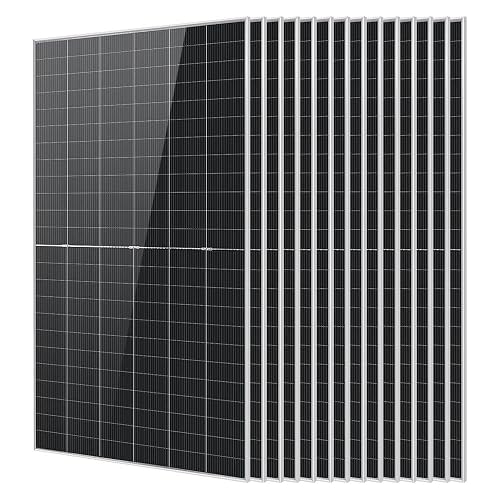 Best budget pick for high output panelsSUNGOLDPOWER 590W Bifacial Solar Panel 14PCSView on Amazon
Our Top Picks
| Product | Best for | Key feature |
|---|---|---|
| Whole House System 10KW Split Phase Kit | Full-home off-grid or backup power | 10 kW split-phase inverter with 16 kWh storage listed |
| 880W Dual 440W Panel Set | Small loads, RVs, sheds and cabins | Two 440W half-cell panels for 12/24/48V systems |
| 1170W 48V Complete Kit with Battery | Mid-size homes with partial backup needs | Six 195W bifacial panels with 2.56 kWh lithium battery |
| 10KW Off-Grid Kit with 9.36kWh Storage | Households wanting larger battery reserves | Twelve 195W panels with two 48V lithium batteries |
| 590W Bifacial 14-Panel Set | Buyers who want high-wattage panels for grid or hybrid use | N-type bifacial modules rated 590W each |
Whole House System 10KW Split Phase Kit
Whole House System:10KW 120V/240V Split Phase Solar Inverter| 48V 314Ah 16kWh High Capacity Energy Storage| 2950W Solar Panel ECO WORTHY 10000W Output Complete Off-Grid Solar Panel Kit for Home
Best for: Full-home off-grid or backup power
This is the most complete kit on the list, aimed at households that want to run most or all of a house without relying on the utility. It suits homes with a dedicated area for ground or roof arrays and owners who plan to size the system carefully with an electrician.
Key specs
- 10 kW inverter output (listed as 10000W)
- 120V/240V split-phase configuration
- 48V 314Ah energy storage, listed as 16 kWh
- 2950W solar array in the listing name
Pros
- Covers inverter, storage and panels in one package
- Split-phase output matches typical US household wiring
- Large storage capacity supports extended outages
Cons
- Installation is complex and usually needs a licensed electrician and permit
- The 2950W array is modest relative to the 10 kW inverter, so output depends on sun hours
Bottom line: Best for owners who want whole-house independence and are prepared for a professional installation.
880W (2×440W) Solar Panels for 12/24/48V System
880W (2×440W) Solar Panels for 12/24/48V System, High-Efficiency Half Cell N-Type 16BB Monocrystalline PV Module Power Charger for RV Marine Rooftop Farm Battery and Other Off-Grid Applications
Best for: Small backup loads
This is a panel-only option for people building or expanding a smaller off-grid or battery-charging system. It fits RV, marine, shed and cabin uses, or as an add-on to an existing setup in Maharashtra’s rural and peri-urban areas.
Key specs
- Two panels rated 440W each, 880W total
- Half-cell N-type monocrystalline construction (per listing)
- Compatible with 12V, 24V and 48V system voltages
Pros
- Flexible voltage compatibility suits many battery banks
- Lower total outlay makes it easy to start small
- Panel-only format lets you choose your own controller and battery
Cons
- You must buy an inverter, controller, batteries and wiring separately
- 880W may not cover heavy household loads such as air conditioners
Bottom line: A sensible starting point for light loads or a second array, not for whole-house power.
6PCS 195W N-Type Bifacial Solar Panel (1170W) + 48V 50Ah Lithium Battery Kit
6PCS 195W N-Type Bifacial Solar Panel(1170W)+48V 50Ah Lithium Battery(2.56kWh)+48V 3500W Solar Inverter+Solar Cables&Mounts ECO-WORTHY 1170W Solar Panel Kit Complete System 48V 3500W Output
Best for: Mid-size homes
This kit bundles six bifacial panels, a lithium battery, a 3500W inverter and mounting hardware. It suits homes with moderate evening loads such as fans, lighting, refrigerators and a few electronics, especially where grid outages are occasional.
Key specs
- Six 195W N-type bifacial panels (1170W total)
- 48V 50Ah lithium battery, listed as 2.56 kWh
- 48V 3500W solar inverter
Pros
- Complete package with cables and mounts included
- Lithium battery needs less upkeep than lead-acid
- Bifacial panels can capture some reflected light
Cons
- 2.56 kWh storage is limited for multi-day outages
- Owners often report that bifacial gain depends heavily on the mounting surface
Bottom line: A balanced choice for mid-size homes that want a complete, mid-range kit with battery backup.
Solar Panel Kit 12PCS 195W with 10KW Inverter and Lithium Batteries
Solar Panel Kit:12PCS 195W Solar Panels(2340W)+2PCS 48V 100AH Cubix Lithium Battery(10.24kWh)+10KW Solar Inverter 120V/240V ECO-WORTHY 10KW Output 9.36KWH Off Grid Solar System Complete Kit for Home
Best for: Larger energy storage
This kit pairs twelve 195W panels with two lithium batteries and a 10 kW inverter. It is better suited to larger homes or small businesses that want more storage than the mid-size kit provides, and that can accommodate a larger roof or ground array.
Key specs
- Twelve 195W panels (2340W total)
- Two 48V 100Ah lithium batteries, listed as 10.24 kWh
- 10 kW inverter, 120V/240V
Pros
- Storage capacity is substantially higher than mid-size kits
- Split-phase output fits typical household wiring
- Scalable array for higher daily generation
Cons
- Requires significant roof or ground space and a sturdy mounting plan
- Installation and permits should be handled by a qualified professional
Bottom line: Suited to owners who need more storage and have the space and budget for a larger installation.
SUNGOLDPOWER 590W Bifacial Solar Panel 14PCS
SUNGOLDPOWER 590W Bifacial Solar Panel 14PCS,N-Type 16BB,High Efficiecy Up to 30% Extra Power,Vmp 44.4V/PCS,for 24V/48Vdc Home Backup,Energy Storage,On Grid/Off-Grid System UL61730 (14*590W Bifacial)
Best for: High-wattage panels for grid or hybrid use
This is a panel-focused set of fourteen 590W bifacial modules intended for 24V or 48V home backup, energy storage and on-grid or off-grid systems. It fits buyers who already have, or plan to buy, a separate inverter and battery and want high-output modules.
Key specs
- Fourteen 590W bifacial panels (8,260W total across the set)
- N-type 16BB cell design (per listing)
- UL61730 certification noted in the listing
Pros
- Very high wattage per panel reduces the number of mounting points
- Certification listed for safety compliance
- Works for both on-grid and off-grid designs
Cons
- No inverter or battery included, so total project cost is higher than the list suggests
- Large, heavy modules need experienced installers and a strong roof structure
Bottom line: Best for experienced builders or installers who want high-wattage modules and will source the rest of the system.
Buying Guide
System size and daily energy use
Start by estimating how many kilowatt-hours your household uses per day. Your monthly electricity bill in Maharashtra shows units consumed, which you can divide by 30 to get a rough daily figure. Panel wattage and inverter size should match that load, with room for appliances that start up with a surge.
Good picks for this: Whole House System 10KW Split Phase Kit, Solar Panel Kit 12PCS 195W with 10KW Inverter
Inverter type and output
Check whether the inverter output matches your home’s voltage and phase. Split-phase 120V/240V configurations are common in US-style wiring, but many Indian homes use single-phase supply, so confirm compatibility with a local electrician before buying.
Good picks for this: Whole House System 10KW Split Phase Kit, 6PCS 195W Complete Kit
Battery capacity and chemistry
Battery kWh determines how long your home can run without sun or grid supply. Lithium chemistries generally need less maintenance and tolerate deeper discharge than lead-acid. Compare listed kWh against your nightly load to estimate backup hours.
Good picks for this: Solar Panel Kit 12PCS 195W with 10KW Inverter, 6PCS 195W Complete Kit
Panel wattage and efficiency
Higher-wattage modules reduce the number of mounting points and wiring runs, but they are larger and heavier. Half-cell and N-type designs are commonly cited for better performance in partial shade and high temperatures, which can matter during Maharashtra’s hot months.
Good picks for this: 880W Dual 440W Panel Set, SUNGOLDPOWER 590W Bifacial Solar Panel 14PCS
Roof and mounting fit
Measure usable roof area and check the load rating of your roof structure. Heavy modules and ground mounts need a plan for wind loading and tilt angle. Many owners find that roof orientation and shading affect output more than panel brand.
Good picks for this: SUNGOLDPOWER 590W Bifacial Solar Panel 14PCS, Solar Panel Kit 12PCS 195W with 10KW Inverter
Certification and safety
Look for listed certifications such as UL 61730 for modules and check that the inverter and battery meet the standards your installer requires. Certifications do not guarantee performance, but they indicate that a product has been evaluated against a recognized safety standard.
Good picks for this: SUNGOLDPOWER 590W Bifacial Solar Panel 14PCS, Whole House System 10KW Split Phase Kit
Installation and permits
Grid-connected or whole-house systems typically require permits, utility approval and a licensed installer. Plug-and-play style small kits can be handled by a confident DIYer, but anything tied into your main panel should be installed by a qualified professional.
Good picks for this: 880W Dual 440W Panel Set, 6PCS 195W Complete Kit
FAQ
What is the typical cost of solar panel in Maharashtra for a home?
Costs depend on system size, battery storage, installation complexity and whether you choose a grid-tied or off-grid design. For a detailed breakdown of how these factors add up, see our guide to Solar Panel System Cost in India: A Practical Homeowner's Guide (2026).
Do I need a battery with a solar system in Maharashtra?
Not always. Grid-tied systems without batteries export excess power and rely on the utility at night. Battery systems give backup during outages but add to the total investment. Our overview of Solar Panel for Home Total Cost: 6 Best Systems Compared for Every Budget (2026) explains how the two approaches compare.
How many panels does an average home need?
It depends on daily consumption and sun hours. A practical method is to divide your daily kWh use by your local peak sun hours, then divide by panel rating to estimate the panel count. Leave margin for losses from heat, dust and wiring.
Can I install solar panels myself?
Small panel-only or plug-and-play kits can be handled by a skilled DIYer, but grid connection, inverter wiring to the main panel and permits require a licensed professional. Consult a qualified electrician before any work on your electrical system.
How long do solar panels last?
Manufacturers commonly specify warranties of around 25 years for panel output, though actual performance varies. Batteries have shorter lifespans that depend on chemistry and cycling. Check warranty terms before buying.
Do solar panels work well in Maharashtra’s heat?
Panel output drops somewhat as temperature rises, so good ventilation under the array matters. Owners often report that tilt angle and airflow matter as much as the brand, especially in summer months.
Are there tax benefits or subsidies for solar in Maharashtra?
Government schemes and net-metering rules change over time and differ by utility and system type. Check current state and central programs with your distribution company and a licensed installer before making decisions.
Conclusion
For most households asking about the cost of solar panel in Maharashtra, the right choice depends on load and backup goals rather than brand alone. The Whole House System 10KW kit suits full-home independence, the 880W panel set fits light loads and expansions, and the 6PCS 195W kit is a balanced mid-size option. The 10KW kit with 9.36 kWh storage serves households needing more reserve, while the 590W bifacial set is best for experienced builders who will source the rest of the system. Compare each listing’s stated specifications against your own energy profile before deciding.
Sources
- Guidance on home solar system sizing, performance factors and buying considerations (energy.gov)
- Research on photovoltaic performance, temperature effects and system design (nrel.gov)
- Information on UL safety certification standards for solar modules and equipment (ul.com)
Related reading
- What Is the Cost of Roof Solar Panels? A Homeowner's Q&A
- What Does the Cost of Thermal Solar Panels Look Like for a Home?
- Vivint Solar Panel Cost: What Homeowners Should Expect Before Signing
About Claire Whitaker
Claire Whitaker is part of our editorial team and reviews and edits our home solar guides, checking product details against manufacturer specifications and owner feedback.