By Claire Whitaker
Updated November 2026
Solar panels for home not on roof are a practical choice when your roof faces the wrong direction, is shaded, is too weak to carry a load, or when you want panels in a yard, on a shed, or on a trailer. This list compares seven widely sold panel kits and modules that owners commonly use for ground mounts, off-grid cabins, RVs and backup power. Selection criteria: wattage and voltage compatibility, mounting flexibility, build quality described in listings, and how well each suits a non-roof setup.
Our top picks at a glance
- 1
 TOP CHOICEBest overallN-Type 16BB 400W Bifacial Solar Panel, 2Pcs 200 Watt Solar PanelView on Amazon
- 2
 TOP CHOICEBest for complete starter kitsECO-WORTHY 200 Watts 12 Volt/24 Volt Solar Panel KitView on Amazon
- 3
 TOP CHOICEBest for portable power stations200W Portable Solar Panel for Power StationView on Amazon
- 4
 Best for light, flexible mountingLensunSolar 50W Flexible Solar Panel, 33×14 inView on Amazon
- 5
 Best for whole-home off-grid10KW Whole House System with 16kWh Storage, Off-Grid Solar Panel KitView on Amazon
- 6
 Best for wet or outdoor sitesECO-WORTHY 400 Watts 4-Pack 100 Watt Monocrystalline Solar PanelsView on Amazon
- 7
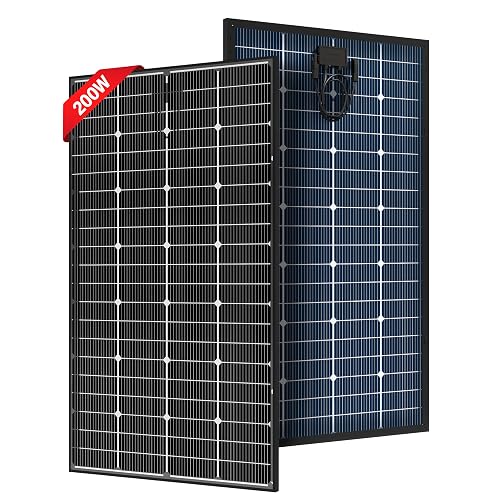 Best for trailers and marine useN-Type 16BB Rigid Solar Module, For RV Home Farm Trailer Camper MarineView on Amazon
Our Top Picks
Quick Comparison
| Product | Best for | Key feature |
|---|---|---|
| N-Type 16BB 400W Bifacial Solar Panel | Best overall | Bifacial, anti-shade design |
| ECO-WORTHY 200W Solar Panel Kit | Complete starter kits | Includes 30A charge controller |
| 200W Portable Solar Panel | Portable power stations | Foldable, USB-C and QC3.0 |
| LensunSolar 50W Flexible Panel | Light, flexible mounting | Lightweight, flexible design |
| 10KW Whole House Solar Kit | Whole-home off-grid | 16kWh storage included |
| ECO-WORTHY 400W 4-Pack | Wet or outdoor sites | IP68 waterproof rating |
| JJN Bifacial 200W Rigid Module | Trailers and marine use | Rigid, 25% efficiency |
N-Type 16BB 400W Bifacial Solar Panel, 2Pcs 200 Watt Solar Panel
N-Type 16BB 400W Bifacial Solar Panel, 2Pcs 200 Watt Solar Panel for 12V/24V Systems, 25.6% High Efficiency, Dual-Module Parallel Anti-Shade Design, for RV Van Marine Home Rooftop Off-Grid
Best for: Best overall
This pair suits owners building a ground-mounted array for a cabin, shed or home backup who want high output per panel.
Pros
- Bifacial design can capture reflected light from the ground.
- Parallel anti-shade design limits losses from partial shading.
Cons
- Needs a separate mounting frame and wiring plan.
ECO-WORTHY 200 Watts 12 Volt/24 Volt Solar Panel Kit
ECO-WORTHY 200 Watts 12 Volt/24 Volt Solar Panel Kit with High Efficiency Monocrystalline Solar Panel and 30A PWM Charge Controller for RV, Camper, Vehicle, Caravan and Other Off Grid Applications
Best for: Complete starter kits
A good fit for first-time owners who want panels, a controller and wiring in one box for a small off-grid setup.
Pros
- Includes a 30A PWM charge controller.
- Supports both 12V and 24V battery systems.
Cons
- PWM controllers are less efficient than MPPT on cold, low-light days.
200W Portable Solar Panel for Power Station
200W Portable Solar Panel for Power Station, 24% High Efficiency ETFE Foldable Solar Panel Charger, QC3.0, Type-C 60W, MC4 Output, IP65 Waterproof, for Outdoor Camping, RV, Emergency Power Supply
Best for: Portable power stations
Designed for campers and emergency kits that need to be moved, folded and set up in sunny spots around the yard.
Pros
- Foldable ETFE surface and IP65 rating for outdoor use.
- Includes USB-C and QC3.0 outputs.
Cons
- Not suited to powering a full house without storage.
LensunSolar 50W Flexible Solar Panel, 33×14 in
Full Black,Waterproof, Lightweight, 25.8% Highest Efficiency Back Contact Solar Cell, For RV, Tent, Van LensunSolar 50W Flexible Solar Panel, 33×14 in
Best for: Light, flexible mounting
Suits curved or lightweight surfaces such as van roofs, tents and small sheds where rigid panels are impractical.
Pros
- Lightweight and bendable for irregular mounting.
- Compact footprint at 33 by 14 inches.
Cons
- Flexible panels generally run hotter and may last less than rigid modules.
10KW Whole House System with 16kWh Storage, Off-Grid Solar Panel Kit
Whole House System:10KW 120V/240V Split Phase Solar Inverter| 48V 314Ah 16kWh High Capacity Energy Storage| 2950W Solar Panel ECO WORTHY 10000W Output Complete Off-Grid Solar Panel Kit for Home
Best for: Whole-home off-grid
For owners who want a ground-mounted system covering a full house load rather than a single appliance.
Pros
- Split-phase 120V/240V inverter suits household wiring.
- Includes battery storage for overnight use.
Cons
- Installation typically requires an electrician and local permits.
ECO-WORTHY 400 Watts 4-Pack 100 Watt Monocrystalline Solar Panels
IP68 Waterproof, 16BB, Perfect for Off Grid PV Power for Home, Camping, Boat, Shed Farm, RV,12V/24V battery ECO-WORTHY 400W Solar Panels N-Type 4pcs 100 Watt 18V Monocrystalline
Best for: Wet or outdoor sites
Useful for sheds, farms and boats where moisture and weather exposure are constant concerns.
Pros
- IP68 waterproof rating listed by the manufacturer.
- Four panels give flexible series or parallel wiring.
Cons
- Four separate panels need more mounting hardware.
Buying Guide
Mounting Method and Ground Clearance
Because these panels are not on a roof, check how each one will be supported. Ground mounts, pole mounts, shed mounts and trailer mounts all need brackets or a stand, so confirm whether the kit includes mounting hardware or whether you will need to buy it separately. Bifacial panels can also collect light reflected from the ground, so the height and surface beneath them matter.
System Voltage and Compatibility
Match the panel voltage to your battery bank and charge controller. Many of the kits here are built for 12V or 24V systems, while the larger whole-house package uses 48V storage and a split-phase inverter. Mixing mismatched components can waste power or damage equipment, so verify compatibility before you buy.
Portability Versus Permanent Installation
Think about whether you need a fixed array or something you can move. Foldable and flexible panels suit camping, tents and vehicles that change location, while rigid modules are better for a permanent ground or yard setup. Weight and wind exposure also increase when a panel is not anchored to a roof structure.
Weather Resistance and Build Quality
Panels outdoors face rain, dust, heat and temperature swings, so look for waterproof ratings and sturdy frames. Listings that mention IP65 or IP68 protection indicate stronger resistance to water and dust. Also consider the cable and connector type, such as MC4 outputs, which are standard for many solar systems.
Total Capacity and Future Expansion
Estimate how much power you actually need, then choose a wattage that covers it with some margin. If you plan to grow the system later, pick panels that can be connected in series or parallel and that match your existing equipment. A slightly larger starting setup often saves money compared with replacing components down the road.
FAQ
Can solar panels work well when they are not on a roof?
Yes, ground-mounted and other non-roof panels often perform well because they can be angled toward the sun and kept clear of nearby shade. Their output still depends on sunlight, location and tilt. Positioning them with a clear view of the sky usually makes the biggest difference.
What is the difference between bifacial and standard panels?
Bifacial panels can capture light on both the front and back surfaces, which can add energy when the ground beneath them is reflective. Standard panels only collect light from the front. Bifacial models are often a good fit for ground mounts with open space underneath.
Do I need a charge controller or inverter with these panels?
A charge controller is needed to regulate power going into a battery bank, and an inverter is needed to convert stored DC power into household AC power. Some portable panels charge power stations directly and do not need a separate controller. Check each product’s included components before purchasing.
How do I secure a solar panel that is not on a roof?
Use a sturdy mounting frame anchored to a stable surface such as a concrete base, a pole or a heavy trailer bracket. Make sure the mount can handle wind loads in your area. Tilting the panel toward the sun and securing all cables away from foot traffic also helps.
Are portable solar panels good enough for home backup power?
Portable panels can support small loads, phone and laptop charging, lights and camping equipment, but they generally will not power a full house on their own. For whole-home backup, a larger battery system and multiple panels are usually required. Estimate your daily energy use before deciding.
Conclusion
If you need a permanent, fixed array for a yard, shed or off-grid home, the larger rigid panel kits and the whole-house package are the better match, provided you have the mounting space and matching components. Choose a 12V or 24V kit with a charge controller if you are building a modest off-grid or RV-style setup.
For camping, vehicles and emergency power, the portable foldable panel and the lightweight flexible panel offer easy setup and transport. Pick the option that matches your power needs, installation plans and how often you plan to move the system.
Related reading
- What Are Solar Thermal Roof Panels and Do They Work for Homes?
- Top 3 Solar Panels on Sloping Roof Mounts for Pitched Homes
- Tesla Roof Tile Solar Panels: What They Are and Whether They Fit Your Home
- Solar Panels on Mobile Home Roof: A Step-by-Step Guide for Homeowners
- Solar Panels Not Roof Mounted: 5 Practical Ground and Pole Options
- Home Roof Solar Panels Cost: A Homeowner's Step-by-Step Breakdown
About Claire Whitaker
Claire Whitaker is part of our editorial team and reviews and edits our home solar guides, checking product details against manufacturer specifications and owner feedback.